
From Beijing to Bucharest: Why Strategic Dialogue Matters in an Emerging Multipolar World
Reflections from the Fifth Wanshou Dialogue on Global Security and a new strategic initiative for Romania
By Valentin PREDA, Founder & President of Diplomacy360
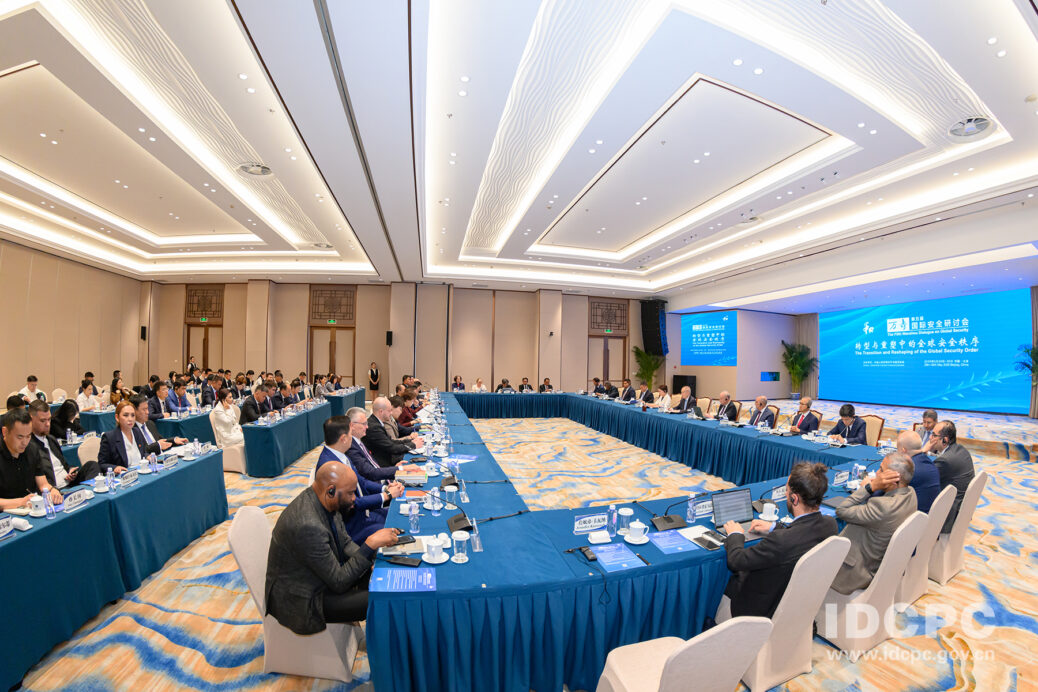
In May 2026, I had the opportunity to participate as a speaker in the Fifth Wanshou Dialogue on Global Security in Beijing, organised by the Chinese People’s Association for Peace and Disarmament.
The Dialogue brought together almost 50 international security experts from more than 30 countries, including the United States, France, Germany, Italy, Poland, Spain, Switzerland, Russia, Türkiye, Egypt, Hungary, South Korea and others.
For me, the importance of the meeting went beyond the formal agenda.
It was an opportunity to listen directly to how experts from different parts of the world perceive the profound changes taking place in the international system — and, perhaps more importantly, to understand where their perceptions converge and where they remain fundamentally different.
That kind of direct dialogue is becoming increasingly important nowadays.
A world in transition
One conclusion was broadly shared: the international system is undergoing a profound transformation, but the shape of what comes next is far from being settled.
The existing security architecture is under pressure. The strategic balance between major powers is changing. Regional powers are becoming more influential. Economic interdependence is increasingly being used as an instrument of strategic influence. Technology — from artificial intelligence and advanced manufacturing to space and defence technologies — is becoming an essential component of most national powers.
At the same time, the dividing line between economic security and national security is becoming increasingly difficult to define.
The war in Ukraine and the one in the Middle East, the evolution of US-China relations, the changing role of Türkiye, the growing weight of India and the Gulf states, and the transformation of Europe’s security environment are not isolated developments.
They are parts of a much larger transition.
The question is therefore not simply whether the world is becoming multipolar.
The more important question for us and for our region is what kind of multipolar world is emerging, who is shaping it as we speak, and what we are doing to shape our own place in it.
My Takeaways from Beijing
I cannot share the discussions literally, as parts of the Dialogue were held under non-public or closed-door arrangements and I have a responsibility to respect that. However, without attributing views to individual speakers, I can share some of the key ideas and questions that emerged from the discussions.
The Chinese perspective presented at the Wanshou Dialogue placed considerable emphasis on the idea of common security: the argument that no country can achieve lasting security in isolation and that security should increasingly be approached through cooperation, multilateralism, dialogue and sustainable development.
China also presented its concepts of the Global Security Initiative, Global Development Initiative, Global Civilization Initiative and Global Governance Initiative as elements of its broader approach to international affairs.
These are Chinese perspectives. Understanding a country’s strategic thinking does not require agreeing with every element of it. But in a world in which China has become a major economic, technological and military power, Europe and the United States cannot afford not to understand how Beijing sees the world — just as China’s decision to organise a Dialogue of this kind reflects the importance of understanding how Europe, the United States and other countries see the world.
This is one of the fundamental lessons I took from the Dialogue.
Beyond geopolitical narratives
There was also an interesting point of convergence among participants from very different countries: a new international order is not yet fully established. It is being shaped now.
And it will be shaped not only by declarations, strategies and diplomatic statements, but by concrete actions.
The decisions that countries take on security, alliances, trade, investment, technology, energy, infrastructure and international cooperation will determine the contours of the system that emerges.
This means that the coming years will matter enormously.
The emerging order may be more multipolar. It may involve a greater role for regional and middle powers. It may produce new forms of economic and technological alignment.
But it may also create new dividing lines.
One particularly important risk is that major powers could increasingly seek security through spheres of strategic, political or economic influence.
For smaller and medium-sized countries, this raises a fundamental question:
Will they have a meaningful voice in shaping the emerging order, or will they simply have to adapt to arrangements negotiated by others?
And where does Romania stand?
This is the question I kept returning to during my conversations in Beijing.
Romania is not at the table of great powers.
But neither is Romania a country without strategic options.
We are an EU and NATO member, a strategic partner of the United States, a Black Sea country, a neighbour of Ukraine and a country positioned at the intersection of Central Europe, Southeast Europe, the Balkans, Türkiye, the Black Sea and the wider neighbourhood extending towards the Caucasus and the Middle East.
Our geography is a strategic asset.
But geography alone does not create influence.
Influence comes from strategy, capabilities, partnerships, economic strength and the ability to participate actively in the conversations that shape the future.
This is where I believe Romania needs a much more ambitious strategic conversation and action plan.
Romania must remain firmly anchored in the European project and contribute more actively to shaping the future of the European Union.
It must continue strengthening its strategic partnership with the United States and its role within NATO.
It needs to deepen its relationship with Türkiye, a country of growing importance for the Black Sea, the Balkans, the Caucasus and the Middle East.
It needs to build stronger relationships with other middle and regional powers, including India and the Gulf states.
And it needs to develop a more sophisticated and pragmatic economic relationship with Asia.
China, in particular, cannot simply be understood through the lens of political differences. China is a major global economic, technological and strategic actor, and its role in the international system will continue to grow.
For Romania, the challenge is not to choose between one part of the world and another.
For Romania, the challenge is to remain firmly anchored in its fundamental strategic partnerships while developing the capacity to engage intelligently, pragmatically and in accordance with its national interests with a much wider range of international actors, including China.
That requires strategic maturity.
Romania cannot afford to be only an observer
The most important question for me is therefore not whether the world is becoming multipolar.
It is: What is Romania doing while the new world order is being formed?
Are we actively participating in the strategic discussions that will define the future of Europe, the Black Sea and our wider neighbourhood?
Are we building the economic and technological capabilities that will give us greater strategic autonomy?
Are we developing relationships with the emerging powers that will shape the global economy?
Are we sufficiently prepared for a world in which security, energy, technology, trade and investment are increasingly interconnected?
And, perhaps most importantly:
Are we thinking strategically enough about where Romania should be in 10, 15 or 20 years?
These questions should not belong only to governments or diplomats.
They concern business leaders, academics, defence and technology experts, civil society and, ultimately, every Romanian citizen.
From Beijing to Bucharest
The conversations in Beijing — both on the record and in more informal settings — were exceptionally active and direct, and I am grateful to the Chinese organisers for the opportunity to participate in such a thoughtful and high-level forum.
I would also like to commend the organisers for the quality of the programme, the breadth of perspectives represented and the level of the international experts brought together in Beijing.
I came away from the Dialogue convinced that there is an enormous amount happening beneath the surface of international politics.
There are disagreements, competing interests and very different interpretations of the future.
But there is also a recognition that the world is changing too quickly for countries to rely only on yesterday’s assumptions.
For Romania, this should be a wake-up call.
We need more strategic thinking.
We need more direct international dialogue.
We need to listen to perspectives that differ from our own — not because we have to agree with them, but because understanding how other powers see the world is an essential part of protecting and redefining our own interests in accordance with the realities of a changing international environment.
And we need to create opportunities for Romanian decision-makers, experts and business leaders to participate in these conversations.
From a Romanian Dialogue to a Regional Dialogue
Early this year, when I first began preparing for this autumn, my intention was to organise a conference in Romania focused primarily on opening a broader public dialogue about what we, as Romanians, should do having known the political situation in Romania and the rapidly changing international environment (here it should be mentioned our initiative announced last year, called “Dialogue for ROMANIA”)
The discussions in Beijing, however, made me realise that our questions cannot be separated from the wider regional transformation taking place around us. Romania’s future is closely connected to the future of Europe and particularly Southeast Europe, the Black Sea, Ukraine, the Balkans, Türkiye and the wider Middle East — and all of these are increasingly influenced by changes in the global balance of power.
I therefore decided to broaden the concept. Rather than organising only a Romanian dialogue about Romania, Diplomacy360 will seek to create a Regional Strategic Dialogue — one that brings the world to the region, brings the region into the global conversation, and ultimately asks what Romania should do in response.
A new strategic dialogue in Romania
This is the thinking behind the Diplomacy360 Strategic Dialogue – Security and Prosperity in an Emerging Multipolar World, which we intend to organise in Romania in late autumn 2026 or early 2027.
The idea evolved from my experience at the Wanshou Dialogue in Beijing and from the many conversations I had there and after with experts representing very different strategic perspectives.
We are preparing to organise in Romania a high-level, closed-door strategic forum:
Diplomacy360 Strategic Dialogue
Security and Prosperity in an Emerging Multipolar World
It will bring together a carefully selected group of senior experts, diplomats, political and business leaders and strategic thinkers from Romania, the United States, China, European countries, Türkiye, India, the Gulf and other important regional powers, with a think-tank expert’s participation from Russia considered if and when the international and diplomatic context makes meaningful engagement possible.
The objective will not be to promote one geopolitical narrative.
It will be to create a serious space for different perspectives to meet.
The focus will be firmly regional: Romania, the Black Sea, Ukraine, Southeast Europe, the Balkans and the wider neighbourhood extending towards Türkiye, the Caucasus and the Middle East.
But these regional questions cannot be separated from the larger transformation of the global order.
We therefore intend to bring together three dimensions:
The Region.
What is happening around us?
The World.
How is the global balance of power changing?
Romania.
What should we do about it?
The ultimate purpose is simple:
To better understand the world that is emerging — and to help Romania and the region prepare for it.
If the emerging international order is to be stable and sustainable, it should not be defined only by what the great powers decide. It should also be shaped by what countries like Romania choose to do.
Romania cannot afford to be only an observer of a changing world. It needs to understand it, engage with it and, where possible, help shape the future of its own region.
This is the spirit in which Diplomacy360 is preparing to launch the Diplomacy360 Strategic Dialogue – Security and Prosperity in an Emerging Multipolar World in Romania, in late autumn 2026 or early 2027.
The Region. The World. Romania’s Strategic Future.
Valentin PREDA
Founder & President of Diplomacy360


 ©2026 All rights reserved Diplomacy360.